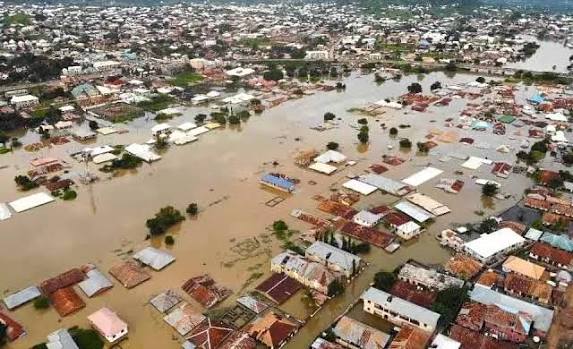
266 LGAs in 33 states are on high alert for severe flooding.
The federal government says 14,118 communities in 33 states and the Federal Capital Territory (FCT) are at risk of severe flooding in 2026.
Joseph Utsev, minister of water resources and sanitation, announced the concerned states in Abuja on Wednesday at the public presentation of the 2026 annual flood outlook (AFO) by the Nigeria Hydrological Services Agency (NIHSA).
Utsev said the high-risk communities are spread across 266 LGAs, based on scientific forecasts and hydrological assessments.
He listed the affected states as Abia, Adamawa, Anambra, Bauchi, Bayelsa, Benue, Borno, Cross River, Delta, Ebonyi, Edo, Enugu, Gombe, Imo, Jigawa, Kaduna and Kano.
Others are Kebbi, Kogi, Kwara, Lagos, Nasarawa, Niger, Ogun, Ondo, Osun, Oyo, Plateau, Rivers, Sokoto, Taraba, Yobe and Zamfara, as well as the FCT.
“States in this category include Adamawa, Anambra, Bauchi, Bayelsa, Benue, Borno, Cross River, Delta, Ebonyi, Edo, Jigawa, Kaduna, Kano, Kebbi, Kogi, Nasarawa, Niger, Ogun, Ondo, Osun, Oyo, Sokoto, Taraba and Zamfara,” the minister said.
He added that 15,597 communities in 405 LGAs across 35 states fall under the moderate flood risk category, noting that Ekiti is the only state not affected.
He said 923 communities in 77 LGAs across 24 states are classified as low-risk areas.
Utsev warned of possible flash and urban flooding in major cities, including Abuja, Lagos, Port Harcourt, Ibadan and Kano.
He said coastal and riverine flooding is expected in Bayelsa, Cross River, Delta, Lagos, Ogun, Rivers and Ondo due to rising sea levels and tidal surges.
“The AFO is not just a scientific report; it is a call to action. Early warning saves lives and reduces economic losses,” the minister said.
Utsev attributed the increasing incidence of flooding to climate variability, rapid urbanisation, inadequate drainage infrastructure and poor land-use practices.
He said the federal government is strengthening hydrological monitoring through improved data systems, automated river gauges and advanced modelling techniques.
The minister added that collaboration with the Nigerian Meteorological Agency (NiMet) and the National Emergency Management Agency (NEMA) is being enhanced to improve forecast accuracy and early warning dissemination.
He urged state governments to integrate flood risk considerations into land-use planning, urban development and infrastructure design.
Utsev also called for improved drainage systems, effective floodplain management and stronger community preparedness to reduce the impact of flooding.
‘FG IMPLEMENTING FLOOD CONTROL PROJECTS’
Speaking at the event, President Bola Tinubu said flooding remains a major national challenge, with recurring incidents since 2012.
Tinubu, who was represented by Balarabe Lawal, minister of environment, said his administration has introduced policies and programmes, including flood control projects, to address the persistent threat.
He said the 2024 Maiduguri flood marked a turning point towards proactive flood and disaster management.
According to the president, the anticipatory action initiative led by the office of the vice-president is strengthening early warning, preparedness and coordinated response.
Tinubu described the AFO as a key planning document guiding early action, mitigation and evacuation strategies nationwide.
He urged stakeholders to utilise the forecasts to protect lives, livelihoods and critical infrastructure.
The president also emphasised the need to harness water resources for economic diversification and sustainable development.
Umar Mohammed, director-general of NIHSA, said the forecast is based on comprehensive, data-driven analysis of flood-prone areas.
Mohammed said the AFO serves as an early warning tool to support planning and coordinated disaster response across the country.
He added that the agency has upgraded its forecasting system to a hybrid AI-integrated model to improve accuracy and lead time.
He said the flood dashboard now enables real-time monitoring and dissemination of alerts to stakeholders.
Mohammed urged residents in vulnerable areas to heed early warnings and adopt preventive measures to reduce risks.
He also called for wider dissemination of the outlook to strengthen preparedness and resilience in communities.
The NIHSA director-general commended the federal government and development partners for their support in preparing the 2026 outlook.