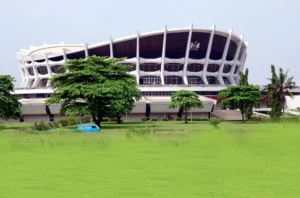
Nigeria spent N21bn to renovate the national theatre — so why is it sitting idle?
national theatre

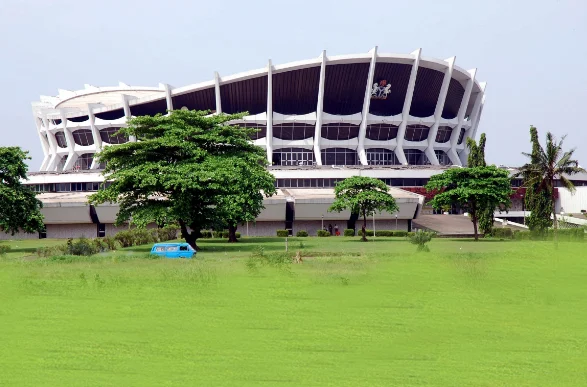
Nigeria spent N21bn to renovate the national theatre — so why is it sitting idle?
The federal government handed the national theatre to the Central Bank of Nigeria (CBN) and the bankers’ committee on July 12, 2020, for a comprehensive renovation: a move widely welcomed by stakeholders as a chance to revive one of Nigeria’s most iconic cultural landmarks.
In February 2021, the federal executive council approved the CBN’s N21 billion renovation request. Years later, the bankers’ committee announced the project was nearly complete.
Lai Mohammed, then minister of information and culture, framed the investment as one that would “renovate, refurbish and commercialise” the complex.
In September 2024, Hannatu Musawa, the current minister of art, culture and the creative economy, described the facility as “a gift to the nation” and a source of national pride.

In July 2024, President Bola Tinubu renamed the complex the Wole Soyinka Centre for Culture and the Creative Arts and inaugurated the national theatre on October 1, 2025, as part of activities to commemorate Nigeria’s 65th independence anniversary.
The building, it seemed, had been restored to its rightful place.
Over one year on, however, stakeholders said the problem is no longer the building. It is what happens inside it, how it is managed, programmed and woven into the wider creative economy.
A BROADER PLAN, HALF-REALISED
Biodun Abe, former technical director of the national theatre and the longest-serving occupant of the role, told TheCable the renovation was never meant to stand alone.
According to him, under the original agreement, the CBN and bankers’ committee would renovate the theatre in exchange for developing about 44 hectares of surrounding land into an entertainment city dedicated to fashion, ICT, music and film.
“The National Theatre was in a very bad state then. The understanding was that the Bankers’ Committee would renovate the facility, hand it back to the government and then proceed with the entertainment city project,” he said.
Abe recalled that workers were initially asked to vacate the complex during the renovation, but labour unions, including the Radio, Television, Theatre and Arts Workers Union of Nigeria (RATTAWU) and the Amalgamated Union of Public Corporations, Civil Service Technical and Recreational Services Employees (AUPCTRE), resisted the move over concerns about the project’s long-term implications.
He said a compromise was eventually reached, with staff temporarily relocated within the complex while renovation work continued.
“The plan was for both projects to move simultaneously. The National Theatre was never meant to stand alone; it was supposed to be part of a much larger creative ecosystem,” he said.
IMPRESSIVE BUILDING, FRUSTRATING PROCESS
The renovated theatre sits on about 23,000 square metres and retains its 5,000-seat main bowl, one of Africa’s largest indoor performance venues. It also houses three cinemas, exhibition halls, banquet facilities, rehearsal spaces and galleries, with a mandate to host theatre, music, film, exhibitions and other cultural activities year-round.
Seun Oloketuyi, founder of the Best of Nollywood (BON) Awards, is among those who have tested that mandate. He staged the 2025 edition at the venue.
His verdict on the building? Impressive. His verdict on the process? Exhausting.
“In terms of the infrastructure, they’ve done a fantastic job. But there are still many things that need to be done to make it customer-friendly. That’s probably why a lot of events are not happening there yet,” he said.
Booking the facility, he said, was unusually cumbersome.
“Normally, you confirm the date, make payment and fill out the necessary forms. But here, there was so much bureaucracy. We were given different forms, payment was delayed, and there were hidden clauses in the contract,” he added.
He also criticised restrictions on access to the venue before the event, saying organisers were unable to complete overnight preparations and were required to end the programme by midnight.
According to him, a request to extend the event, even with an offer to pay additional fees, was rejected, forcing organisers to cancel the after-party.
Oloketuyi added that it took several months to recover the event’s refundable deposit.

“The facilities are excellent, but there are too many rules, and they’re enforced too rigidly,” he said.
A LANDMARK WITHOUT A NEIGHBOURHOOD
Jide Taiwo, a creative industry stakeholder, argued that renovating the theatre without improving its surroundings is a recipe for repetition.
“The creative industry has suffered decline for many years, and that’s why the National Theatre fell into disrepair. Fixing the theatre without fixing everything around it means we’re likely to face the same problem again,” he told TheCable.
Poor roads, inadequate lighting and the absence of complementary businesses, he said, limit the venue’s pull.
“If Davido has a concert there, where is the after-party? It’s probably somewhere else, and people have to spend another 30 minutes navigating potholes and dark roads to get there. Beyond the National Theatre itself, there isn’t much to attract people to the area,” he added.
He pointed to London’s Battersea Power Station, where the surrounding district was regenerated alongside the landmark itself.
“The National Theatre shouldn’t exist as a standalone project. The infrastructure around it doesn’t support the creative sector at all,” Taiwo said.
Also speaking, music executive Bizzle Osikoya said the cost of hiring the venue remains one of the biggest barriers to wider adoption.
“The sound and everything about the venue are great, but the price is what is stopping people. Even younger alternative artistes who want to perform there feel it’s too expensive,” he said.
Osikoya said many venues abroad operate revenue-sharing models with promoters rather than relying on high upfront rental fees.
“I understand they spent a lot of money on the renovation and have to recoup their investment, but the pricing needs to become more accessible,” the talent manager said.
He argued that the theatre should be positioned for emerging and mid-tier artistes, not only the industry’s giants.
“The focus shouldn’t be on Davido or Wizkid for now. Artistes like Victony, Fola and Shoday are the ones who should be using the National Theatre because it’s the right size for them. That’s why I admired Adekunle Gold for taking the bold step of staging a concert there,” he said.
Adeniran Makinde, president of the National Association of Nigerian Theatre Arts Practitioners (NANTAP), identified the problem in the operating model rather than the brickwork.
In his view, the facility is run largely as an event centre waiting for bookings, not as a national cultural institution with year-round programming.
“You don’t build an edifice like this as a cultural centre without programmes to run it. You can’t just wait for people to book the venue. That’s not how these places operate,” he told TheCable.
Makinde said a consistent calendar of theatre productions, festivals, exhibitions and cultural events would keep the complex active while making it commercially viable.
“If you have programmes running throughout the year, the place will remain busy and become a business hub. The structure and policy they’re operating with now are simply not working,” he said.

He cited the Kennedy Center in Washington, D.C., as an example of a cultural institution sustained by continuous programming rather than venue rentals.
SIGNS OF LIFE
For all the frustration, Davido recently announced a three-day residency at the venue, and British-Nigerian rapper Dave is expected to perform there later in the year.
Whether those bookings signal a new chapter or simply a landmark learning to fill its calendar one marquee name at a time depends on whether the deeper questions of programming, pricing and planning are ever answered.